
This article was written by dietetic student Emma Kortmansky & reviewed by Melanie Betz MS, RD, CSR, FNKF, FAND.
*Please note that this post contains clearly identified affiliate links. As an Amazon affiliate, I may earn a small commission on qualifying purchases (at no extra cost to you).
What better way to eat your veggies than in a stir fry?! Crispy, colorful, and packed with flavor, stir fries are one of the easiest (and tastiest!) ways to load up on nutrient-dense vegetables. But traditional stir fry sauces can be loaded with sodium – sometimes more than your entire daily limit in just a few spoonfuls.
That’s why I created this low sodium stir fry sauce that’s just as delicious, but way better for you. With a few simple swaps, you can enjoy bold, flavor-packed meals that are friendly to your kidneys – and your taste buds!
Table of Contents
Benefits of A Low Sodium Diet
Lowers Blood Pressure
High sodium intake is strongly linked to high blood pressure, a major cause of heart disease, kidney disease and stroke. Reducing sodium helps lower blood pressure in both children and adults.
Reduces Risk of Heart Disease and Stroke
Cardiovascular disease is the leading cause of death globally. A low sodium diet significantly reduces the risk of heart attacks and strokes.
Improves Overall Health
The WHO recommends consuming less than 2,000 mg of sodium per day (about 5 grams of salt). This simple dietary change can prevent a wide range of chronic diseases.
How Much Sodium Is In Stir Fry Sauce?
Let’s start with the numbers. Just 1 tablespoon of traditional soy sauce has about 900 mg of sodium. And how many tablespoons are in your average stir fry? Probably more than one.
Even “low sodium” soy sauce still contains around 500-600 mg per tablespoon. Teriyaki and other bottled sauces aren’t any better – they can sneak in even more.
Bottom line: stir fry sauce can be a major source of hidden sodium in your meal.
Store-Bought Low-Sodium Stir-Fry Sauce
If you’re not ready to DIY, there are a few decent low sodium options on the shelves:
| Product | Sodium Content |
|---|---|
| Primal Kitchen* Organic No Soy Teriyaki Sauce & Marinade | 220 mg sodium per tablespoon |
| Kikkoman* Preservative Free Stir Fry Sauce Marinades and Sauce | 190 mg sodium per tablespoon |
| 365* by Whole Foods Market, Organic Stir Fry Cooking Sauce | 170 mg sodium per tablespoon |
| Organic Asian Fusion* Low Sodium Teriyaki Sauce | 125 mg sodium per tablespoon |
Low Sodium Stir Fry Sauce Ingredients
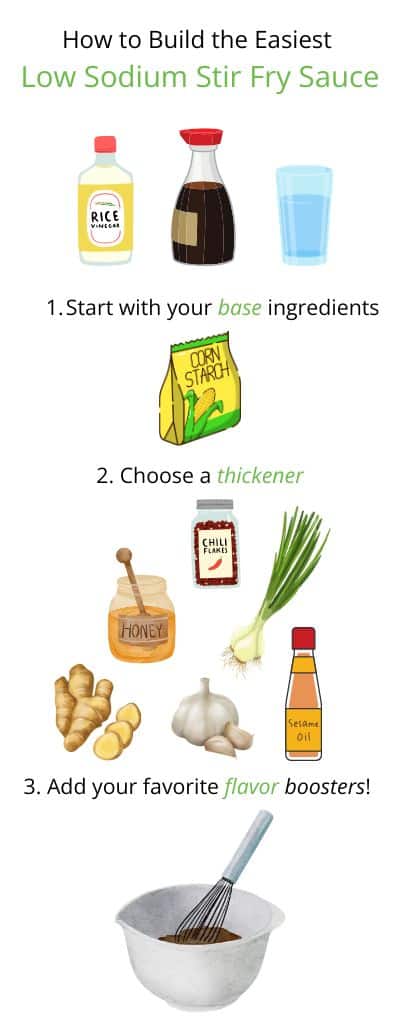
The beauty of making your own stir fry sauce is that you control everything. Here’s how to build a delicious sauce with way less salt.
Bases
These form the body of your sauce. Use one or combine a few:
- Lower sodium soy sauce or tamari
- No salt added vegetable broth
- Rice vinegar or apple cider vinegar (for tang)
- Unsweetenend pineapple juice (adds sweetness & acidity)
- Water – seriously underrated as a base extender
Thickeners
Want that glossy, sticky stir fry texture? Try:
- Cornstarch (classic and easy)
- Arrowroot powder (good for reheating)
- All-purpose flour
Flavor Boosters
This is where it gets fun! Skip the salt and use:
- Garlic and ginger (fresh is best!)
- Toasted sesame oil (a little goes a long way)
- Lime or lemon juice
- Chili flakes or sriracha (watch sodium in sauces)
- Maple syrup, honey, or a touch of brown sugar for balance
How To Customize Your Low Sodium Stir Fry
You’ve got the sauce – now make it a meal!
Vegetables
Stir fries are perfect for loading up on colorful veggies. My favorites are:
- Bell peppers
- Broccoli
- Snap peas
- Mushrooms
- Zucchini
Pro tip: Cut everything about the same size so it cooks evenly.
Proteins
Make your stir fry more filling with:
- Chicken breast
- Tofu
- Shrimp
- Edamame
- Lean beef
Try using your sauce as a marinade first for even more flavor!
What To Service With
Try pairing with:
- Brown rice or jasmine rice
- Low sodium ramen or rice noodles
- Cauliflower rice (for a lower carb option)
What To Do With Leftover Sauce
Made a big batch? Don’t toss it – this sauce is super versatile!
Marinades
Use it to marinate chicken, tofu, or shrimp before grilling or baking.
Dipping Sauces
Serve alongside dumplings, spring rolls, or veggie skewers.
Salad Dressings (Trust Me!)
Whisk with olive oil and a little citrus for a bold, Asian-inspired vinaigrette. Great on cabbage slaw or cold noodle salads.
Low Sodium Stir Fry Sauce
Ingredients
- 1/2 cup coconut aminos
- 1/2 cup water
- 1 tsp sesame oil
- 1/2 tbsp rice vinegar
- 2 cloves garlic minced or grated
- 1 tsp ginger grated
- 1 tbsp honey
- 1 tbsp cornstarch
- 2 tbsp green onion thinly sliced
- Pinched red pepper flakes optional
Instructions
- In a bowl, combined all ingredients and whisk until well combined.
- For the body of the stir fry, heat 1 tablespoon olive oil in large skillet or wok over medium-low heat.
- Add vegetables of choice, and cook, stirring occasionally, for 7-10 minutes, or until slightly softened.
- Cook protein of choice in a separate pan. Once fully cooked, add into skillet with vegetables.
- Pour sauce into the stir fry, and cook for 2-3 minutes, or until sauce thickens.
- Plate on top of rice or noodles and top with more green onions.
- Enjoy!
Notes
cholesterol, 0 g fiber, 1 g added sugar, 0 g protein, 119 mg sodium, 1 mg calcium, 15 mg potassium, 1 mg phosphorus, 0 mg oxalate
If you enjoyed this recipe, check out these other low sodium sauces (that actually taste good) – perfect if you’re looking for something other than stir fry sauce.
This low sodium chicken marinade and low sodium hot sauce are also easy ways to flavor your meals without the added salt!
Happy eating!
Melanie

half a cup of coconut amino is 4000mg sodium or more. nice Low salt recipe! 🤣
Hi Van! Thank you so much for your comment. Let me help shine some light on how this really is a low sodium recipe. Sodium CAN vary quite a bit between brands of coconut aminos – we recommend using Coconut Secret – which has 2,160mg sodium per 1/2 cup. Notice that the recipe makes SIXTEEN servings, so even with bits of sodium from the other ingredients, this brings the total sodium per serving to 119mg, well below the FDA definition of a “low sodium food” of <140mg/serving. Math is cool, huh?
My husband I just made a stir fry with this sauce recipe and it was delicious! I was glad that it made so much sauce, too. We will definitely be making this recipe again. Thank you!
Yay! So glad that you enjoyed it. Thanks for sharing!
What brand of coconut amino’s are you using for a half cup to be low sodium?
I really like Coconut Secret!
They are now Nutiva…but are the lowest sodium one I have found.